what happens to sumo wrestlers when they retire
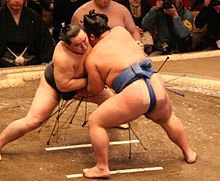 A sumo match (tori-kumi) between yokozuna Asashōryū (left) and komusubi Kotoshōgiku in January 2008 | |||||||||||||||||||||||||||||||
| Focus | Assure fighting | ||||||||||||||||||||||||||||||
|---|---|---|---|---|---|---|---|---|---|---|---|---|---|---|---|---|---|---|---|---|---|---|---|---|---|---|---|---|---|---|---|
| Hardness | Total contact | ||||||||||||||||||||||||||||||
| Country of origin | Nippon | ||||||||||||||||||||||||||||||
| Ancestor arts | Tegoi | ||||||||||||||||||||||||||||||
| Descendant arts | Jujutsu, Jieitaikakutōjutsu | ||||||||||||||||||||||||||||||
| Olympic sport | No, simply IOC recognized | ||||||||||||||||||||||||||||||
| Official website | www | ||||||||||||||||||||||||||||||
| |||||||||||||||||||||||||||||||
| Sumo | |||||
|---|---|---|---|---|---|
 "Sumo" in kanji | |||||
| Japanese name | |||||
| Kanji | 相撲 | ||||
| |||||
Sumo (Japanese: 相撲, Hepburn: sumō , [sɯmoː], lit. "hit one another") [1] is a form of competitive full-contact wrestling where a rikishi (wrestler) attempts to strength his opponent out of a circular ring (dohyō) or into touching the ground with any body office other than the soles of his feet (commonly by throwing, shoving or pushing him downwardly).
Sumo originated in Japan, the only country where it is proficient professionally, where it is considered the national sport.[ii] It is considered a gendai budō, which refers to modern Japanese martial arts, but the sport has a history spanning many centuries. Many ancient traditions have been preserved in sumo, and fifty-fifty today the sport includes many ritual elements, such as the employ of salt purification, from Shinto.
Life as a wrestler is highly regimented, with rules regulated by the Japan Sumo Association. About sumo wrestlers are required to live in communal sumo grooming stables, known in Japanese as heya, where all aspects of their daily lives—from meals to their manner of wearing apparel—are dictated past strict tradition.
From 2008 to 2016, a number of loftier-profile controversies and scandals rocked the sumo earth, with an associated result on its reputation and ticket sales. These accept besides affected the sport's power to attract recruits.[iii] Despite this setback, sumo'southward popularity and general omnipresence has rebounded due to having multiple yokozuna (or grand champions) for the beginning time in a number of years and other high-contour wrestlers grabbing the public's attention.[iv]
Etymology [edit]
The spoken give-and-take sumō goes back to the verb sumau/sumafu, meaning "compete" or "fight". The written give-and-take goes back to the expression sumai no sechi ( 相撲の節 ), which was a wrestling competition at the regal courtroom during the Heian menstruation. The characters from sumai, or sumō today, mean "to strike each other". There is also an alternating spelling of 角力 , which can be constitute in the Nihon Shoki. Here, the first character means "corner", but serves as a phonetic element equally ane reading of information technology is sumi, while the second character means "force".
Sumō is also a general term for wrestling in Japanese. For example, udezumō ( 腕相撲 , "arm sumō") means "arm wrestling", and yubizumō ( 指相撲 , "finger sumō") ways "finger wrestling". The professional sumo observed by the Japan Sumo Association is called ōzumō ( 大相撲 ), or "grand sumo".
History [edit]
Antiquity (pre-1185) [edit]
Prehistoric wall paintings point that sumo originated from an agronomical ritual trip the light fantastic toe performed in prayer for a skilful harvest.[5] The first mention of sumo tin be establish in a Kojiki manuscript dating back to 712, which describes how possession of the Japanese islands was decided in a wrestling match between the kami known equally Takemikazuchi and Takeminakata.
Takemikazuchi was a god of thunder, swordsmanship, and conquest, created from the blood that was shed when Izanagi slew the fire-demon Kagu-tsuchi. Takeminakata was a god of water, wind, agriculture and hunting, and a distant descendant of the storm-god Susanoo. When Takemikazuchi sought to conquer the land of Izumo, Takeminakata challenged him in hand-to-hand gainsay. In their melee, Takemikazuchi grappled Takeminakata's arm and crushed it "similar a reed," defeating Takeminakata and challenge Izumo.[vi] [7]
The Nihon Shoki, published in 720, dates the first sumo match between mortals to the year 23 BC, when a man named Nomi no Sukune fought against Taima no Kuehaya at the request of Emperor Suinin and eventually killed him, making him the mythological ancestor of sumo.[5] [eight] Co-ordinate to the Nihon Shoki, Nomi broke a rib of Taima with ane kicking, and killed him with a kick to the back every bit well.[6] Until the Japanese Eye Ages, this unregulated form of wrestling was often fought to the death of one of the fighters.[5] The first historically-attested sumo fights were held in 642 at the court of Empress Kōgyoku to entertain a Korean legation. In the centuries that followed, the popularity of sumo within the court increased its formalism and religious significance. Regular events at the Emperor'due south courtroom, the sumai no sechie, and the institution of the first gear up of rules for sumo fall into the cultural heyday of the Heian period.
Japanese Middle Ages (1185–1603) [edit]
With the collapse of the Emperor's central authorization, sumo lost its importance in the court; during the Kamakura catamenia, sumo was repurposed from a ceremonial struggle to a course of armed forces combat preparation among samurai.[five] [eight] Past the Muromachi period, sumo had fully left the seclusion of the court and became a pop event for the masses, and among the daimyō information technology became common to sponsor wrestlers. Sumotori who successfully fought for a daimyō's favor were given generous support and samurai status. Oda Nobunaga, a particularly avid fan of the sport, held a tournament of 1,500 wrestlers in February 1578. Considering several bouts were to be held simultaneously inside Oda Nobunaga'southward castle, circular arenas were delimited to hasten the proceedings and to maintain the condom of the spectators. This result marks the invention of the dohyō, which would be developed into its current grade up until the 18th century.[5] The winner of Nobunaga'south tournament was given a bow for being victorious and he began dancing to testify the war-lord his gratitude.[6]
Edo period (1603–1867) [edit]
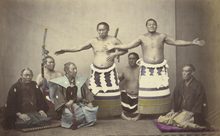
Because sumo had become a nuisance due to wild fighting on the streets, particularly in Edo, sumo was temporarily banned in the urban center during the Edo period. In 1684, sumo was permitted to be held for charity events on the belongings of Shinto shrines, as was common in Kyoto and Osaka. The kickoff sanctioned tournament took place in the Tomioka Hachiman Shrine at this time. An official sumo organization was developed, consisting of professional wrestlers at the disposal of the Edo administration. Many elements date from this period, such as the dohyō-iri, the heya organization, the gyōji and the mawashi. The 18th century brought forth several notable wrestlers such every bit Raiden Tameemon, Onogawa Kisaburō and Tanikaze Kajinosuke, the first historical yokozuna.
Since 1868 [edit]

Sumo match in Tokyo c. 1890s
The Meiji Restoration of 1868 brought about the end of the feudal system, and with it the wealthy daimyō as sponsors. Due to a new fixation on Western culture, sumo had come to be seen as an embarrassing and astern relic, and internal disputes dissever the central clan. The popularity of sumo was restored when Emperor Meiji organized a tournament in 1884; his instance would make sumo a national symbol and contribute to nationalist sentiment following armed services successes confronting Korea and Mainland china. The Japan Sumo Clan reunited on 28 December 1925 and increased the number of annual tournaments from two to four, and so to six in 1958. The length of tournaments was extended from ten to xv days in 1949.[6]
- Gallery
-

Kanjin Grand Sumo Tournament (circa 1843)
-
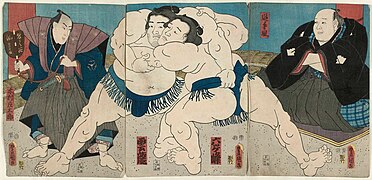
Sumo wrestling scene c. 1851
-

Somagahana Fuchiemon, c. 1850
Rules and customs [edit]

The elementary principle of sumo is that a match is decided by a fighter first either touching the ground exterior the circular dohyō (ring) with whatsoever function of the torso, or touching the ground within the ring with any part of the body other than the soles of the feet. The wrestlers try to reach this by pushing, tossing, striking and often by outwitting the opponent.[9] The Japan Sumo Association currently distinguishes 82 kimarite (winning techniques), some of which come from judo.[10] Illegal moves are called kinjite, which include strangulation, hair-pulling, bending fingers, gripping the crotch area, kicking, poking optics, punching and simultaneously hit both the opponent'south ears. The most common basic forms are grabbing the opponent by the mawashi (belt) and and so forcing him out, a style called yotsu-zumō ( 四つ相撲 ), or pushing the opponent out of the ring without a firm grip, a style chosen oshi-zumō ( 押し相撲 ).
The dohyō, which is constructed and maintained past the yobidashi, consists of a raised pedestal on which a circle four.55 m (14.9 ft) in diameter is delimited by a series of rice-straw bales. In the heart of the circle at that place are two starting lines (shikiri-sen), backside which the wrestlers line upward for the tachi-ai, the synchronized charge that initiates the match.[11] [12] The management of the match is incumbent on the gyōji, a referee who is supported by 5 shimpan (judges). In some situations, a review of the gyōji 'due south determination may be needed. The shimpan may convene a conference in the centre of the band, chosen a mono-ii. This is done if the judges decide that the decision over who won the tour needs to be reviewed; for example, if both wrestlers appear to touch on the basis or stride out of the band at the same time. In these cases, sometimes video is reviewed to see what happened. Once a decision is made, the chief gauge volition announce the decision to the spectators and the wrestlers alike. They may order a bout to be restarted, or leave the decision as given by the gyōji. Occasionally the shimpan will overrule the gyōji and give the bout to the other wrestler. On rare occasions the referee or judges may award the win to the wrestler who touched the footing starting time. This happens if both wrestlers impact the ground at nigh the aforementioned time and information technology is decided that the wrestler who touched the ground second had no risk of winning, his opponent'south superior sumo having put him in an irrecoverable position. The losing wrestler is referred to as existence shini-tai ("dead trunk") in this case.[13]
The maximum length of a lucifer varies depending on the division. In the peak division, the limit is four minutes, although matches ordinarily only last a few seconds. If the match has non yet ended subsequently the allotted fourth dimension has elapsed, a mizu-iri (water intermission) is taken, after which the wrestlers continue the fight from their previous positions. If a winner is still non establish after another 4 minutes, the fight restarts from the tachi-ai after another mizu-iri. If this still does not result in a decision, the issue is considered a draw. This is an extremely rare result, with the final such depict beingness called in September 1974.[14]
A special attraction of sumo is the multifariousness of observed ceremonies and rituals, some of which have been cultivated in connection with the sport and unchanged for centuries. These include the ring-entering ceremonies (dohyō-iri) at the beginning of each tournament twenty-four hours, in which the wrestlers announced in the ring in elaborate kesho-mawashi, merely also such details as the tossing of salt into the band by the wrestlers, which serves as a symbolic cleansing of the ring,[13] and rinsing the rima oris with chikara-mizu ("power water") before a fight, which is similar to the ritual earlier entering a Shinto shrine. Additionally, before a match begins the ii wrestlers perform and repeat a warm up routine called shikiri. The top sectionalisation is given iv minutes for shikiri, while the second division is given 3, afterwards which the timekeeping guess signals to the gyōji that fourth dimension is up.[13]
Traditionally, sumo wrestlers are renowned for their great girth and body mass, which is ofttimes a winning factor in sumo. No weight divisions are used in professional sumo; a wrestler can sometimes face up an opponent twice his own weight. However, with superior technique, smaller wrestlers can control and defeat much larger opponents.[xv] The average weight of peak division wrestlers has connected to increase, from 125 kilograms (276 lb) in 1969 to over 150 kilograms (330 lb) by 1991, and was a tape 166 kilograms (366 lb) as of Jan 2019.[16]
Professional sumo [edit]

Sumo wrestlers gather in a circle around the gyōji (referee) in the dohyō-iri (ring-entering ceremony)
Professional sumo is organized by the Japan Sumo Clan.[14] The members of the association, chosen oyakata, are all quondam wrestlers, and are the only people entitled to railroad train new wrestlers. All professional wrestlers must be a member of a grooming stable (or heya) run past one of the oyakata, who is the stablemaster for the wrestlers nether him. In 2007, 43 preparation stables hosted 660 wrestlers.[17]
To plow professional, wrestlers must take completed at least ix years of compulsory education and see minimum elevation and weight requirements.[13] In 1994, the Japanese Sumo Clan required that all sumo wrestlers be a minimum 173 centimeters (5.7 feet) in height. This prompted sixteen-yr-old Takeji Harada of Nihon (who had failed half-dozen previous eligibility tests) to have four separate cosmetic surgeries over a period of 12 months to add an extra 15 cm (vi in) of silicone to his scalp, which created a big, protruding burl on his head.[18] In response to this, the JSA stated that they would no longer accept aspiring wrestlers who surgically enhanced their height, citing health concerns.[19] In 2019, The Japan Times reported that the height requirement was 167 cm (5.5 ft), and the weight requirement was 67 kg (148 lb), although they too claimed that a "blind eye" is turned for those "just shy" of the minimums.[xx]
All sumo wrestlers take wrestling names chosen shikona ( 四股名 ), which may or may not be related to their real names. Frequently, wrestlers take picayune choice in their names, which are given to them by their stablemasters, or by a supporter or family unit member who encouraged them into the sport. This is specially true of foreign-born wrestlers. A wrestler may change his wrestling name during his career, with some changing theirs several times.[14]
Professional sumo wrestling has a strict hierarchy based on sporting merit. The wrestlers are ranked according to a system that dates dorsum to the Edo menstruation. They are promoted or demoted according to their performance in vi official tournaments held throughout the twelvemonth, which are called honbasho. A advisedly prepared banzuke list the full hierarchy is published two weeks prior to each sumo tournament.[21]
In addition to the professional person tournaments, exhibition competitions are held at regular intervals every twelvemonth in Nippon, and roughly in one case every ii years, the top-ranked wrestlers visit a foreign land for such exhibitions. None of these displays are taken into account in determining a wrestler's futurity rank. Rank is determined only by performance in grand sumo tournaments.[11]
Sumo divisions [edit]
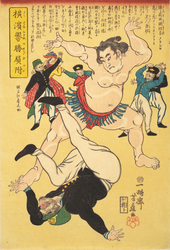
Foreigner and sumo wrestler, 1861
The six divisions in sumo, in descending order of prestige, are:
- makuuchi ( 幕内 ) or makunouchi ( 幕の内 ).[13] Maximum 42 wrestlers; Further divided into five ranks
- jūryō ( 十両 ). Fixed at 28 wrestlers
- makushita ( 幕下 ). Fixed at 120 wrestlers
- sandanme ( 三段目 ). Fixed at 200 wrestlers
- jonidan ( 序二段 ). About 200 wrestlers
- jonokuchi ( 序ノ口 or 序の口 ). Around fifty wrestlers
Wrestlers enter sumo in the everyman jonokuchi division and, ability permitting, work their way up to the top division. A broad demarcation in the sumo world tin can be seen betwixt the wrestlers in the summit 2 divisions known as sekitori ( 関取 ) and those in the four lower divisions, known commonly by the more generic term rikishi ( 力士 ). The ranks receive different levels of bounty, privileges, and status.[22]
The topmost makuuchi sectionalisation receives the about attention from fans and has the most circuitous hierarchy. The majority of wrestlers are maegashira ( 前頭 ) and are ranked from the highest level 1 downward to nigh 16 or 17. In each rank are two wrestlers, the higher rank is designated every bit "eastward" and the lower equally "west", so the list goes #1 east, #1 westward, #ii east, #ii west, etc.[23] Above the maegashira are the 3 champion or titleholder ranks, chosen the san'yaku, which are not numbered. These are, in ascending gild, komusubi ( 小結 ), sekiwake ( 関脇 ), and ōzeki ( 大関 ). At the tiptop of the ranking system is the rank of yokozuna ( 横綱 ).[22]
Yokozuna, or grand champions, are generally expected to compete for and to win the top sectionalisation tournament championship on a regular footing, hence the promotion criteria for yokozuna are very strict. In full general, an ōzeki must win the title for ii consecutive tournaments or an "equivalent operation" to be considered for promotion to yokozuna.[14] More than 1 wrestler tin can concur the rank of yokozuna at the same time.
In antiquity, sumo was solely a Japanese sport. Since the 1900s, however, the number of foreign-born sumo wrestlers has gradually increased. In the beginning of this catamenia, these few foreign wrestlers were listed as Japanese, merely particularly since the 1960s, a number of loftier-contour foreign-born wrestlers became well-known, and in more contempo years take fifty-fifty come to boss in the highest ranks. In the 10 years since January 2009, five of the nine wrestlers promoted to ōzeki have been foreign-built-in,[24] and a Japanese had non been named yokozuna from 1998 until the promotion of Kisenosato Yutaka in 2017. This and other bug eventually led the Sumo Association to limit the number of foreigners allowed to one in each stable.
Women and sumo [edit]
Women are non immune to compete in professional person sumo. They are also non immune to enter the wrestling band (dohyō), a tradition stemming from Shinto and Buddhist beliefs that women are "impure" considering of menstrual blood.[25] [26] [27]
A course of female person sumo ( 女相撲 , onnazumo ) existed in some parts of Japan before professional sumo was established.[28] The 2018 flick, The Chrysanthemum and the Guillotine, depicts female sumo wrestlers at the time of civil unrest post-obit the 1923 Great Kantō convulsion.
Professional sumo tournaments [edit]

The sumo hall of Ryōgoku in Tokyo during the May, 2006 tournament
Since 1958, vi Grand Sumo tournaments or honbasho take been held each year: three at the Ryōgoku Kokugikan in Ryōgoku, Tokyo (Jan, May, and September), and one each in Osaka (March), Nagoya (July), and Fukuoka (November). Each tournament begins on a Dominicus and runs for 15 days, catastrophe too on a Sun.[thirteen] [29] The tournaments are organized in a mode akin to a McMahon organisation tournament; each wrestler in the top two divisions (sekitori) has ane lucifer per day, while the lower-ranked wrestlers compete in 7 bouts, nigh i every 2 days.
Each mean solar day is structured so that the highest-ranked contestants compete at the end of the solar day. Thus, wrestling starts in the morning time with the jonokuchi wrestlers and ends at around half dozen o'clock in the evening with bouts involving the yokozuna. The wrestler who wins the most matches over the fifteen days wins the tournament championship (yūshō) for his partition. If 2 wrestlers are tied for the meridian, they wrestle each other and the winner takes the title. 3-way ties for a title are rare, at least in the top sectionalisation. In these cases, the three wrestle each other in pairs with the get-go to win two in a row take the tournament. More than complex systems for championship playoffs involving four or more wrestlers also exist, but these are unremarkably only seen in determining the winner of one of the lower divisions.

The matchups for each solar day of the tournament are determined past the sumo elders who are members of the judging sectionalization of the Japan Sumo Association. They meet every morning at 11 am and announce the following solar day's matchups around 12 pm. An exception are the terminal day fifteen matchups, which are announced much afterwards 24-hour interval 14.[xiii] Each wrestler only competes against a option of opponents from the same division, though modest overlaps tin occur between two divisions. The first bouts of a tournament tend to be betwixt wrestlers who are inside a few ranks of each other.[13] Afterwards, the choice of opponents takes into account a wrestler's prior functioning. For example, in the lower divisions, wrestlers with the aforementioned record in a tournament are more often than not matched up with each other and the terminal matchups oft involve undefeated wrestlers competing against each other, even if they are from opposite ends of the division. In the top division, in the concluding few days, wrestlers with exceptional records often have matches confronting much more highly ranked opponents, including san'yaku wrestlers, especially if they are even so in the running for the summit partitioning championship. Similarly, more than highly ranked wrestlers with very poor records may observe themselves fighting wrestlers much farther downward the partition.
For the yokozuna and ōzeki, the get-go calendar week and a one-half of the tournament tends to be taken upwardly with bouts against the top maegashira, komusubi, and sekiwake, with the bouts within these ranks beingness concentrated into the terminal five days or so of the tournament (depending on the number of top-ranked wrestlers competing). Traditionally, on the final 24-hour interval, the last three bouts of the tournament are between the top vi ranked wrestlers, with the top two competing in the last matchup, unless injuries during the tournament prevent this.
Sure match-ups are prohibited in regular tournament play. Wrestlers who are from the aforementioned training stable cannot compete against each other, nor tin can wrestlers who are brothers, fifty-fifty if they join different stables. The ane exception to this dominion is that training stable partners and brothers can confront each other in a championship-deciding playoff match.
The final day of the tournament is called senshūraku, which literally means "the pleasure of a thousand autumns". This colorful proper name for the culmination of the tournament echoes the words of the playwright Zeami to stand for the excitement of the decisive bouts and the celebration of the victor. The Emperor'due south Cup is presented to the wrestler who wins the elevation-sectionalisation makuuchi championship. Numerous other (mostly sponsored) prizes are also awarded to him. These prizes are often rather elaborate, ornate gifts, such equally giant cups, decorative plates, and statuettes. Others are quite commercial, such as one bays shaped similar a behemothic Coca-Cola bottle.
Promotion and relegation for the next tournament are determined by a wrestler's score over the fifteen days. In the top division, the term kachikoshi ways a score of 8–7 or better, as opposed to makekoshi, which indicates a score of 7–8 or worse. A wrestler who achieves kachikoshi about always is promoted further up the ladder, the level of promotion being higher for improve scores.[thirteen] Meet the makuuchi article for more details on promotion and relegation.
A top-division wrestler who is not an ōzeki or yokozuna and who finishes the tournament with kachikoshi is also eligible to be considered for one of the 3 prizes awarded for "technique", "fighting spirit", and defeating the most yokozuna and ōzeki the "outstanding operation" prize. For more information see sanshō.
For the list of upper divisions champions since 1909, refer to the list of summit division champions and the list of second division champions.
A professional sumo bout [edit]

Sumo wrestlers at the Thousand Tournament in Osaka, March 2006
Sumo fight at the Kokugikan in Tokyo, Japan
At the initial charge, both wrestlers must jump up from the crouch simultaneously after touching the surface of the ring with 2 fists at the start of the bout. The referee (gyōji) tin restart the tour if this simultaneous bear upon does not occur.[13]
Upon completion of the bout, the referee must immediately designate his conclusion past pointing his gunbai or war-fan towards the winning side. The winning technique (kimarite) used past the winner would and then be announced to the audience. The wrestlers then return to their starting positions and bow to each other earlier retiring.
The referee's determination is not final and may be disputed by the five judges seated effectually the ring. If this happens, they meet in the center of the ring to hold a mono-two (a talk about things). After reaching a consensus, they can uphold or reverse the referee'due south decision or order a rematch, known equally a torinaoshi.
A winning wrestler in the top division may receive boosted prize money in envelopes from the referee if the matchup has been sponsored. If a yokozuna is defeated by a lower-ranked wrestler, information technology is common and expected for audience members to throw their seat cushions into the ring (and onto the wrestlers), though this practice is technically prohibited.
In contrast to the time in bout grooming, bouts are typically very short, usually less than a minute (almost of the time only a few seconds). Extremely rarely, a bout tin can become on for several minutes.
If a bout lasts upward to 4 minutes, the referee or 1 of the judges sitting around the ring may call a mizu-iri or "water break". The wrestlers are carefully separated, have a brief suspension, and and then return to the exact position they left, equally determined past the referee. If after iv more than minutes, they are still deadlocked, they may have a second break, after which they commencement from the beginning. Farther deadlock with no end of the bout in sight can lead to a draw (hikiwake), an extremely rare outcome in modern sumo. The final draw in the top segmentation was in September 1974.[14]
Life as a professional person sumo wrestler [edit]

Young depression-ranking sumo wrestlers at the Tomozuna Stable in Tokyo cease their daily workout routine with a footwork drill
A professional person sumo wrestler leads a highly regimented way of life. The Sumo Clan prescribes the behavior of its wrestlers in some detail. For example, the association prohibits wrestlers from driving cars, although this is partly out of necessity as many wrestlers are too big to fit behind a steering bike.[30] Breaking the rules tin result in fines and/or suspension for both the offending wrestler and his stablemaster.
On entering sumo, they are expected to grow their hair long to form a topknot, or chonmage, like to the samurai hairstyles of the Edo period. Furthermore, they are expected to wear the chonmage and traditional Japanese dress when in public, assuasive them to be identified immediately as wrestlers.
The blazon and quality of the dress depends on the wrestler's rank. Rikishi in jonidan and beneath are allowed to wear but a thin cotton wool robe chosen a yukata, even in winter. Furthermore, when outside, they must clothing a form of wooden sandal chosen geta. Wrestlers in the makushita and sandanme divisions tin wear a grade of traditional curt overcoat over their yukata and are allowed to wear straw sandals, chosen zōri. The higher-ranked sekitori tin can vesture silk robes of their own pick, and the quality of the garb is significantly improved. They as well are expected to wear a more elaborate form of topknot chosen an ōichō (big ginkgo leaf) on formal occasions.
Similar distinctions are made in stable life. The junior wrestlers must get up earliest, around v am, for training, whereas the sekitori may start around vii am. When the sekitori are grooming, the inferior wrestlers may have chores to do, such every bit assisting in cooking the lunch, cleaning, and preparing the bathroom, holding a sekitori 'due south towel, or wiping the sweat from him. The ranking hierarchy is preserved for the social club of precedence in bathing after training, and in eating lunch.
Wrestlers are not normally immune to eat breakfast and are expected to have a siesta-like nap after a large tiffin.[thirteen] The nearly common type of luncheon served is the traditional sumo meal of chankonabe, which consists of a simmering stew of various meat and vegetables cooked at the tabular array, and usually eaten with rice.[xiii] This regimen of no breakfast and a large lunch followed by a sleep is intended to assistance wrestlers put on a lot of weight and so as to compete more effectively.
In the afternoon, the junior wrestlers again usually have cleaning or other chores, while their sekitori counterparts may relax, or deal with work issues related to their fan clubs. Younger wrestlers besides nourish classes, although their education differs from the typical curriculum of their non-sumo peers. In the evening, sekitori may go out with their sponsors, while the inferior wrestlers generally stay at home in the stable, unless they are to accompany the stablemaster or a sekitori equally his tsukebito (manservant) when he is out. Becoming a tsukebito for a senior member of the stable is a typical duty. A sekitori has a number of tsukebito, depending on the size of the stable or in some cases depending on the size of the sekitori. The inferior wrestlers are given the nigh mundane tasks such as cleaning the stable, running errands, and even washing or massaging the exceptionally large sekitori while only the senior tsukebito accompany the sekitori when he goes out.
The sekitori are given their own room in the stable, or may live in their ain apartments, every bit do married wrestlers; the junior wrestlers slumber in communal dormitories. Thus, the globe of the sumo wrestler is carve up broadly between the junior wrestlers, who serve, and the sekitori, who are served. Life is especially harsh for recruits, to whom the worst jobs tend to be allocated, and the dropout charge per unit at this stage is loftier.
The negative health furnishings of the sumo lifestyle can get credible afterward in life. Sumo wrestlers have a life expectancy between 60 and 65, more 20 years shorter than the average Japanese male, every bit the nutrition and sport have a toll on the wrestler'south body. Many develop type 2 diabetes or loftier blood pressure, and they are prone to heart attacks due to the enormous amount of body mass and fat that they accumulate. The excessive intake of alcohol can lead to liver bug and the stress on their joints due to their backlog weight can cause arthritis. Recently, the standards of weight gain are becoming less strict, in an attempt to improve the overall wellness of the wrestlers.[31] [32]
Salary and payment [edit]
As of 2018[update], the monthly salary figures (in Japanese yen) for the acme 2 divisions were:[33]

Yokozuna Asashōryū performing the distinctive dohyō-iri of his rank
- yokozuna: ¥3 million, about United states of america$26,500
- ōzeki: ¥2.5 meg, about US$22,000
- san'yaku: ¥ane.8 1000000, near US$16,000
- maegashira: ¥one.4 million, virtually US$12,500
- jūryō: ¥1.i million, well-nigh US$nine,500
Wrestlers lower than the second-highest segmentation, who are considered trainees, receive only a fairly pocket-sized assart instead of a salary.
In addition to the basic salary, sekitori wrestlers also receive additional bonus income, called mochikyūkin, 6 times a yr (in one case every tournament, or basho) based on the cumulative performance in their career to engagement. This bonus increases every fourth dimension the wrestler scores a kachikoshi (with larger kachikoshi giving larger raises). Special increases in this bonus are also awarded for winning the top partitioning championship (with an extra large increase for a "perfect" championship victory with no losses or zenshō-yusho), and too for scoring a gold star or kinboshi (an upset of a yokozuna by a maegashira).
San'yaku wrestlers too receive a relatively small additional tournament allowance, depending on their rank, and yokozuna receive an boosted allowance every 2nd tournament, associated with the making of a new tsuna belt worn in their ring entering ceremony.
Also, prize money is given to the winner of each divisional championship, which increases from ¥100,000 for a jonokuchi victory upward to ¥10 million for winning the top division. In addition to prizes for a championship, wrestlers in the meridian division giving an exceptional performance in the optics of a judging panel can as well receive 1 or more of iii special prizes (the sanshō), which are worth ¥ii million each.[34]
Individual summit division matches can besides be sponsored past companies, with the resulting prize money called kenshōkin.[13] For bouts involving yokozuna and ōzeki, the number of sponsors can exist quite large, whereas for lower-ranked matchups, no bout sponsors may be agile at all unless i of the wrestlers is especially popular, or unless a company has a policy of sponsoring all his matchups. As of 2019[update], a unmarried sponsorship cost ¥70,000, with ¥60,000 going to the winner of the bout and ¥10,000 deducted past the Nippon Sumo Association for costs and fees.[35] Immediately after the match, the winner receives an envelope from the referee with half of his share of the sponsorship, while the other one-half is put in a fund for his retirement.[35] No prize money is awarded for bouts decided by a fusenshō or forfeit victory.
Apprentice sumo [edit]
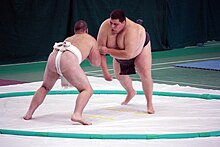
Bulgarian amateurs – on the right is the national motorcoach Hristo Hristov
Sumo is too skillful as an amateur sport in Japan, with participants in college, high school, grade school or company workers on works teams. Open apprentice tournaments are also held. The sport at this level is stripped of most of the ceremony. Nearly new entries into professional sumo are inferior high school graduates with piddling to no previous experience,[36] but the number of wrestlers with a collegiate background in the sport has been increasing over the past few decades.[37] The International Herald Tribune reported on this tendency in November 1999, when more a third of the wrestlers in the top two divisions were academy graduates.[38] Japan Sport Scientific discipline Academy and Nihon University are the colleges that have produced the almost professional sumo wrestlers.[36] The latter produced Hiroshi Wajima, who in 1973 became the first, and remains the only, wrestler with a collegiate groundwork to reach yokozuna.[37]
The most successful amateur wrestlers (usually college champions) are allowed to enter professional person sumo at makushita (tertiary segmentation) or sandanme (quaternary sectionalisation) rather than from the very bottom of the ladder. These ranks are called makushita tsukedashi and sandanme tsukedashi, and are currently equivalent to makushita 10, makushita 15, or sandanme 100 depending on the level of amateur success accomplished. All amateur athletes entering the professional ranks must be nether 23 to satisfy the entry, except those who authorize for makushita tsukedashi or sandanme tsukedashi, who may be upwardly to 25.
The International Sumo Federation was established to encourage the sport's evolution worldwide, including holding international championships. A fundamental aim of the federation is to take sumo recognized every bit an Olympic sport. Accordingly, amateur tournaments are divided into weight classes (men: Lightweight upwards to 85 kg (187 lb), Middleweight up to 115 kg (254 lb), Heavyweight over 115 kg (254 lb), and Open Weight (unrestricted entry), and include competitions for female wrestlers (Lightweight up to 65 kg (143 lb), Middleweight upwards to lxxx kg (180 lb), Heavyweight over 80 kg (180 lb), and Open up Weight).
Amateur sumo clubs are gaining in popularity in the United States, with competitions regularly being held in major cities across the country. The The states Sumo Open, for example, was held in the Los Angeles Convention Centre in 2007 with an audience of iii,000.[39] The sport has long been popular on the Westward Declension and in Hawaii, where it has played a function in the festivals of the Japanese ethnic communities. Now, nevertheless, the sport has grown across the sphere of Japanese diaspora and athletes come from a variety of indigenous, cultural, and sporting backgrounds.
Amateur sumo is particularly strong in Europe. Many athletes come up to the sport from a groundwork in judo, freestyle wrestling, or other grappling sports such as sambo. Some Eastern European athletes have been successful enough to be scouted into professional sumo in Japan, much like their Japanese amateur counterparts. The most notable of these to date is the Bulgarian Kotoōshū, who is the highest-ranking foreign wrestler who was formerly an amateur sumo athlete.
Brazil is some other middle of apprentice sumo, introduced past Japanese immigrants who arrived during the beginning half of the twentieth century. The offset Brazilian sumo tournament was held in 1914.[40] Sumo took root in immigrant centers in southern Brazil, particularly São Paulo, which is now home to the only purpose-congenital sumo training facility outside Japan.[41] Beginning in the 1990s, Brazilian sumo organizations fabricated an effort to interest Brazilians without Japanese beginnings in the sport, and past the mid-2000s an estimated 70% of participants came from outside the Japanese-Brazilian community.[40] Brazil is likewise a heart for women's sumo.[41] A small number of Brazilian wrestlers have fabricated the transition to professional sumo in Japan, including Ryūkō Gō and Kaisei Ichirō.
Wear [edit]
Sumo wrestlers wear mawashi, which is essentially a thick 30-human foot-long belt, that they necktie in knots in the back.[42] They have an official thickness and strength requirement. During matches, the wrestler volition grab onto the other wrestler's mawashi and use it to help them and make moves during a lucifer.[43] The mawashi they clothing practicing versus in a tournament is essentially the same except for the fabric. The different mawashi that the wrestlers wear differentiate their rank. Peak rated wrestlers wear dissimilar colors of silk mawashi during tournament, while lower rated wrestlers are limited to just black cotton fiber.[43]
Their hair is put in a topknot, and wax is used to go the hair to stay in shape. Wax is applied to sumo wrestlers' hair daily past sumo hairdressers (Tokoyama).[44] The topknot is a type of Samurai hairstyle which was once popular in Nihon during the Edo period.[44] The topknot is hard for some foreigners' hair considering their hair is not equally fibroid and straight as Japanese hair. Once a wrestler joins a stable, he is required to grow out his hair in order to grade a topknot.[44]
Outside of tournaments and practices, in daily life, sumo wrestlers are required to wear traditional Japanese clothes.[45] They must article of clothing these traditional wearing apparel all the time in public. What they can wear in public is too determined by rank. Lower rated wrestlers must wear a yukata at all times, fifty-fifty in winter, where higher rated wrestlers have more choice in what they wear.[45]
Gallery [edit]
-

Initial full squat with heels up, Sonkyo ( 蹲踞 ) in Japanese
See also [edit]
- Controversies in professional person sumo
- Culture of Japan
- Glossary of sumo terms
- Kimarite, list of winning moves in sumo
- List of active sumo wrestlers
- List of past sumo wrestlers
- List of sumo stables
- List of sumo tape holders
- List of sumo tournament top division champions
- List of sumo tournament 2d division champions
- List of sumo video games
- List of years in sumo
- Listing of yokozuna
- Lists of sumo wrestlers
- Ssireum, traditional Korean wrestling
- Robot-sumo, robot competition inspired by sumo
- Naki Sumo Crying Baby Festival
References [edit]
Citations [edit]
- ^ "Sumo".
- ^ "What Is Sumo?". Kids Spider web Nippon. Ministry building of Foreign Affairs. Retrieved May sixteen, 2020.
- ^ "Refuse in apprentices threatens future of national sport". Asahi Shimbun. Archived from the original on June 28, 2013. Retrieved June 23, 2013.
- ^ "Revival of sumo's popularity" (in Japanese). Saga Shinbun. Retrieved December eight, 2014.
- ^ a b c d due east Sharnoff, Lora (August 13, 2013). "History of Sumo". United states Dojo . Retrieved Dec 29, 2019.
- ^ a b c d Blaine Henry (Apr 14, 2020). "History Lesson: Sumo Wrestling's Ancient Origins". Fight-Library.com.
- ^ Ashkenazi, Michael (2003). Handbook of Japanese Mythology . ABC-CLIO. p. 266. ISBN9781576074671.
- ^ a b Shigeru Takayama. "Encyclopedia of Shinto: Sumō". Kokugakuin University. Retrieved December 29, 2019.
- ^ "Winning a Sumo Bout". Kids Web Nippon. Ministry building of Foreign Diplomacy. Retrieved May 16, 2020.
- ^ "Kimarite Menu". Japan Sumo Association. Archived from the original on July ix, 2009. Retrieved January xx, 2010.
- ^ a b Hall, Mina (1997). The Big Book of Sumo: History, Practise, Ritual, Fight . Stone Span Press. ISBN1-880656-28-0.
- ^ Pathade, Mahesh. "what is Dohyo". Kheliyad . Retrieved March 9, 2020.
- ^ a b c d e f g h i j k l m Morita, Hiroshi. "Sumo Q&A". NHK World-Japan . Retrieved December 25, 2020.
- ^ a b c d e Sharnoff, Lora (1993). Grand Sumo. Weatherhill. ISBN0-8348-0283-X.
- ^ "Rules of Sumo". Beginner's Guide of Sumo. Nippon Sumo Clan. Archived from the original on June one, 2007. Retrieved June 26, 2007.
- ^ "SUMO/ Heavier wrestlers blamed for increase in serious injuries". Asahi Shimbun. February 19, 2019. Retrieved March 8, 2019.
- ^ "Sumo Beya Guide". Nippon Sumo Clan. Archived from the original on July 15, 2007. Retrieved July 8, 2007.
- ^ Ashmun, Chuck (1994). "Wrestlers Go Great Lengths To Qualify". Seattle Times . Retrieved October 15, 2018.
- ^ "Silicone Raises Sumo Hopeful to New Heights". July 7, 1994 – via LA Times.
- ^ Gunning, John (January xiii, 2019). "Sumo 101: Becoming a rikishi". The Nippon Times . Retrieved August 13, 2020.
- ^ Kamiya, Setsuko (February 19, 2010). "Steeped in tradition, Shinto, sumo is as well scandal-stained". Japan Times . Retrieved August 16, 2017.
- ^ a b "Banzuke". Beginner's Guide of Sumo. Japan Sumo Association. Archived from the original on June 30, 2007. Retrieved June 27, 2007.
- ^ "Sumo FAQ - Professional rankings: The Banzuke". scgroup.com. Archived from the original on October one, 2012.
- ^ "SumoDB Ozeki promotion search".
- ^ Yoshida, Reiji (April 30, 2018). "Banning women from the sumo band: centuries-sometime tradition, direct-up sexism or something more complex?". The Japan Times . Retrieved December eleven, 2019.
- ^ Pathade, Mahesh. "women sumo wrestling restrictions". Kheliyad . Retrieved March ix, 2020.
- ^ "Female Medics Rushed to Aid a Man Who Collapsed on a Sumo Ring. They Were Promptly Told to Get out". news.yahoo.com . Retrieved December i, 2020.
- ^ Miki, Shuji (April 21, 2018). "SUMO ABC (75) / Banning women from the dohyo is baseless in this solar day and age - The Japan News". Japan News/Yomiuri Shimbun. Archived from the original on Apr 23, 2018. Retrieved April 23, 2018.
- ^ An exception to this dominion occurred when Hirohito, the old Emperor of Japan, died on Sabbatum, January vii, 1989. The tournament that was to showtime on the following day was postponed to start on Monday, January 9 and finish on Monday, January 24.
- ^ Seales, Rebecca (December 1, 2017). "Inside the scandal-striking earth of sumo". BBC News . Retrieved October 1, 2018.
- ^ "Condign a Sumo Wrestler". Sumo East and Due west. Discovery Aqueduct. Archived from the original on Baronial 31, 2005. Retrieved Nov 18, 2005.
- ^ "Un Statistics Division – Demographic and Social Statistics". Retrieved Nov 18, 2005.
- ^ "Rikishi Salaries" (in Japanese). November 29, 2018. Retrieved Dec 3, 2018.
- ^ "Sumo Questions". Retrieved November 18, 2005.
- ^ a b "秋場所から懸賞金額アップ、手取り変わらず積立金↑" (in Japanese). Nikkan Sports. May xxx, 2019. Retrieved July 22, 2020.
- ^ a b Gunning, John (March 18, 2019). "Sumo 101: College graduates in sumo". The Japan Times . Retrieved Dec 25, 2020.
- ^ a b Gunning, John (November xi, 2020). "Universities offer foreign wrestlers new path to pro sumo". The Japan Times . Retrieved December 25, 2020.
- ^ Kattoulas, Velisarios (November ix, 1999). "College Sumo Wrestlers Overshadow Quondam Guard". The New York Times . Retrieved December 25, 2020.
- ^ My First Date With Sumo (2007) Gould, Chris Archived September 28, 2012, at the Wayback Machine
- ^ a b Benson, Todd (January 27, 2005). "Brazil's Japanese Preserve Sumo and Share It With Others". The New York Times . Retrieved November 21, 2016.
- ^ a b Kwok, Matt (August 2, 2016). "'Sumo feminino': How Brazil's female sumo wrestlers are knocking downward gender barriers". CBC News . Retrieved November 21, 2016.
- ^ "Sumo Equipment". December v, 2015.
- ^ a b "What Do Sumo Wrestlers Wear During a Match?". LIVESTRONG.COM . Retrieved October 19, 2019.
- ^ a b c "The Topknot". Sportsrec. September 14, 2018.
- ^ a b "Things Y'all Didn't Know Nigh Sumo Wrestlers". September 16, 2014.
Further reading [edit]
- Adams, Andy; Newton, Clyde (1989). Sumo. London, UK: Hamlyn. ISBN0600563561.
- Benjamin, David (2010). Sumo: A Thinking Fan'southward Guide to Japan'due south National Sport. North Clarendon, Vermont, U.s.a.: Tuttle Publishing. ISBN978-four-8053-1087-8.
- Bickford, Lawrence (1994). Sumo And The Woodblock Impress Masters. Tokyo, New York: Kodansha International. ISBN4770017529.
- Buckingham, Dorothea M. (1997). The Essential Guide to Sumo. Honolulu, United states of america: Bess Press. ISBN1880188805.
- Cuyler, P.L.; Doreen Simmons (1989). Sumo From Rite to Sport. New York: Weatherhill. ISBN0834802031.
- Hall, Mina (1997). The Big Volume of Sumo. Berkeley, CA: Stone Bridge Printing. ISBN1880656280.
- Ito, Katsuharu (the 34th Kimura Shonosuke) (2017). The Perfect Guide To Sumo, in Japanese and English language. Translated by Shapiro, David. Kyoto, Japan: Seigensha. ISBN978-4-86152-632-nine.
- Kenrick, Douglas M. (1969). The Book of Sumo: Sport, Spectacle, and Ritual. New York: Weatherhill. ISBN083480039X.
- Newton, Clyde (2000). Dynamic Sumo. New York and Tokyo: Kodansha International. ISBN4770025084.
- Patmore, Angela (1991). The Giants of Sumo. London, Uk: Macdonald Queen Anne Press. ISBN0356181200.
- PHP Institute; Kitade, Seigoro, eds. (1998). Chiliad Sumo Fully Illustrated. Translated by Iwabuchi, Deborah. Tokyo: Yohan Publications. ISBN978-4-89684-251-seven.
- Sacket, Joel (1986). Rikishi The Men of Sumo. text past Wes Benson. New York: Weatherhill. ISBN0834802147.
- Sargent, John A. (1959). Sumo The Sport and The Tradition. Rutland, Vt.: Charles E. Tuttle Company. ISBN0804810842.
- Schilling, Marking (1984). Sumo: A Fan's Guide. Tokyo, Nihon: The Japan Times, Ltd. ISBNfour-7890-0725-1.
- Shapiro, David (1995). Sumo: A Pocket Guide. Rutland, Vermont, USA & Tokyo, Japan: Charles E. Tuttle Company. ISBN0-8048-2014-7.
- Sharnoff, Lora (1993) [1st pub. 1989]. K Sumo: The Living Sport and Tradition (2d ed.). New York: Weatherhill. ISBN0-8348-0283-Ten.
- Sports Watching Association (Japan); Kakuma, Tsutomu, eds. (1994). Sumo Watching. Translated by Iwabuchi, Deborah. New York: Weatherhill. ISBN4896842367.
- Takamiyama, Daigoro; John Wheeler (1973). Takamiyama The Globe of Sumo. Tokyo, New York: Kodansha International. ISBN0870111957.
- Yamaki, Hideo (2017). Notice Sumo: Stories From Yobidashi Hideo. Translated by Newton, Clyde. Tokyo: Gendai Shokan. ISBN978-4768457986.
External links [edit]
- Nihon Sumo Kyokai Official K Sumo Home Page
- The Sumo Forum
- Live-Stream and Video-on-Demand from Grand Sumo Tournament on NHK Japan (english language)
- Sumo FAQ
- Searchable Sumo Database
- Sumo News and Analysis
wimbishcapaidep1952.blogspot.com
Source: https://en.wikipedia.org/wiki/Sumo
0 Response to "what happens to sumo wrestlers when they retire"
Post a Comment