Were Book Burners Too We Read the Books and Burnt Them

Contemporary book burning
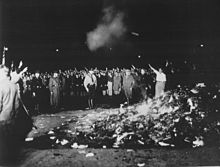
Thousands of books smoulder in a huge bonfire as Germans give the Nazi salute during the wave of volume-burnings that spread throughout Germany.
Book burning is the deliberate destruction by fire of books or other written materials, usually carried out in a public context. The burning of books represents an element of censorship and commonly gain from a cultural, religious, or political opposition to the materials in question.[1]
In some cases, the destroyed works are irreplaceable and their called-for constitutes a severe loss to cultural heritage. Examples include the burning of books and burying of scholars under China's Qin Dynasty (213–210 BCE), the obliteration of the Library of Baghdad (1258), the destruction of Aztec codices past Itzcoatl (1430s), the burning of Maya codices on the order of bishop Diego de Landa (1562), and the burning of Jaffna Public Library in Sri Lanka (1981).
In other cases, such every bit the Nazi book burnings, copies of the destroyed books survive, but the instance of book burning becomes emblematic of a harsh and oppressive regime which is seeking to censor or silence some aspect of prevailing culture.
Book burning can be an human action of contempt for the volume's contents or author, and the act is intended to depict wider public attention to this opinion.
Art destruction is related to volume burning, both because it might accept similar cultural, religious, or political connotations, and considering in various historical cases, books and artworks were destroyed at the same time.
In modern times, other forms of media, such as phonograph records, video tapes, and CDs accept also been burned, shredded, or crushed.
When the burning is widespread and systematic, destruction of books and media can go a meaning component of cultural genocide.
Historical background [edit]
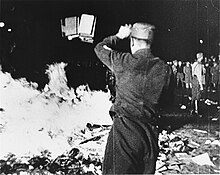
The burning of books has a long history as a tool that has been wielded past authorities both secular and religious, in their efforts to suppress dissenting or heretical views that are believed to pose a threat to the prevailing order.
seventh century BCE [edit]
According to the Tanakh (Hebrew Bible), in the 7th century BCE Rex Jehoiakim of Judah burned role of a scroll that Baruch ben Neriah had written at prophet Jeremiah'south dictation (Jeremiah 36).
Burning of books and burial of scholars in China (210–213 BCE) [edit]
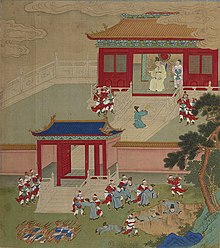
In 213 BCE Qin Shi Huang, the first emperor of the Qin Dynasty, ordered the Burning of books and burying of scholars and in 210 BCE he supposedly ordered the live burying of 460 Confucian scholars in order to stay on his throne. Though the burning of books is well established, the live burying of scholars has been disputed by modern historians who doubt the details of the story, which first appeared more than a century after in the Han Dynasty official Sima Qian's Records of the Yard Historian. Some of these books were written in Shang Xiang, a superior school founded in 2208 BCE. The effect caused the loss of many philosophical treatises of the Hundred Schools of Thought. Treatises which advocated the official philosophy of the authorities ("legalism") survived.
Christian volume burnings [edit]
In the New Testament's Acts of the Apostles, it is claimed that Paul performed an exorcism in Ephesus. After men in Ephesus failed to perform the same feat many gave up their "curious arts" and burned the books because apparently, they did not work.
And many that believed, came and confessed and shewed their deeds. Many of them likewise which used curious arts, brought their books together, and burned them before all men: and they counted the price of them, and constitute information technology fifty thousand pieces of silver.[2]
Afterwards the Starting time Council of Nicea (325 CE), Roman emperor Constantine the Great issued an edict against nontrinitarian Arians which included a prescription for systematic book-burning:
"In addition, if any writing composed by Arius should be plant, information technology should be handed over to the flames, so that not only will the wickedness of his instruction be obliterated, just nothing will be left even to remind anyone of him. And I hereby brand a public order, that if someone should be discovered to have subconscious a writing equanimous past Arius, and non to have immediately brought information technology forward and destroyed it by burn down, his penalisation shall be decease. As soon every bit he is discovered in this law-breaking, he shall be submitted for upper-case letter penalisation....."[iii]
According to Elaine Pagels, "In Advertizing 367, Athanasius, the zealous bishop of Alexandria... issued an Easter letter in which he demanded that Egyptian monks destroy all such unacceptable writings, except for those he specifically listed every bit 'acceptable' even 'canonical'—a list that constitutes the present 'New Testament'".[4] (Pagels cites Athanasius's Paschal letter of the alphabet (letter 39) for 367 CE, which prescribes a catechism, simply her citation "cleanse the church building from every defilement" (page 177) does non explicitly appear in the Festal letter.[5]) Heretical texts do non turn up as palimpsests, scraped make clean and overwritten, as do many texts of Classical antiquity. According to author Rebecca Knuth, multitudes of early Christian texts have been every bit thoroughly "destroyed" as if they had been publicly burnt.[half-dozen]
In 1759 Pope Clement XIII decreed that all books of biologist Linnaeus to exist burned.[7] [8]
Burning of Nestorian books [edit]
Activity by Cyril of Alexandria (c. 376–444) brought fire to almost all the writings of Nestorius (386–450) shortly later 435.[nine] 'The writings of Nestorius were originally very numerous',[10] nevertheless, they were non office of the Nestorian or Oriental theological curriculum until the mid-sixth century, unlike those of his instructor Theodore of Mopsuestia, and those of Diodorus of Tarsus, fifty-fifty so they were not key texts, so relatively few survive intact, cf. Baum, Wilhelm and Dietmar W. Winkler. 2003. The Church of the Due east: A Curtailed History. London: Routledge.
Called-for of Arian books [edit]
Co-ordinate to the Chronicle of Fredegar, Recared, Male monarch of the Visigoths (reigned 586–601) and first Cosmic king of Espana, following his conversion to Catholicism in 587, ordered that all Arian books should be collected and burned; and all the books of Arian theology were reduced to ashes, forth with the house in which they had been purposely collected.[eleven] [12] Which facts demonstrate that Constantine'due south edict on Arian works was non rigorously observed, as Arian writings or the theology based on them survived to exist burned much later on in Spain.
Burning of Jewish manuscripts in 1244 [edit]
In 1244, as an consequence of the Disputation of Paris, twenty-four carriage loads of Talmuds and other Jewish religious manuscripts were attack burn down by French constabulary officers in the streets of Paris.[13] [14]
Called-for of Aztec and Mayan manuscripts in the 1560s [edit]
During the Castilian colonization of the Americas, numerous books written past indigenous peoples were burned past the Spaniards. Several books[ quantify ] written by the Aztecs were burnt by Castilian conquistadors and priests during the Castilian conquest of Yucatán. Despite opposition from Cosmic friar Bartolomé de las Casas, numerous books found by the Spanish in Yucatán were burnt on the gild of Bishop Diego de Landa in 1562. De Landa wrote on the incident that "We plant a big number of books in these characters and, every bit they contained nix in which were not to be seen as superstition and lies of the devil, we burned them all, which they (the Maya) regretted to an amazing degree, and which caused them much affliction".[fifteen]
Book burnings in Tudor and Stuart England [edit]
The founding of the Church building of England after King Henry Viii bankrupt away from the Cosmic Church led to the targeting of English Catholics by Protestants. During the Tudor and Stuart periods, Protestant citizens loyal to the Crown attacked Catholic religious sites across England, ofttimes called-for whatsoever religious texts they found. These acts were encouraged by the Crown, who pressured the general public to take role in such "spectacles". According to American historian David Cressy, over "the course of the sixteenth and seventeenth centuries book burning developed from a rare to an occasional occurrence, relocated from an outdoor to an indoor procedure, and changed from a bureaucratic to a quasi-theatrical performance".[16]
Burning of Washington during the War of 1812 [edit]
During the War of 1812, a British expeditionary force routed an American militia at Bladensburg. Shortly thereafter, the British marched into Washington, D.C., briefly capturing and occupying the city. In retaliation for the American destruction of Port Dover, the British ordered the destruction of several public buildings in the city, including the Library of Congress, erected just fourteen years prior. The U.S. Capitol was also burnt past the British, with books from the Library of Congress existence used to fire the building. Both the library and the Capitol were rebuilt later on the war.[17]
Institutions dedicated to book burnings [edit]
Anthony Comstock's New York Club for the Suppression of Vice, founded in 1873, inscribed book burning on its seal, as a worthy goal to exist achieved. Comstock'southward total accomplishment in a long and influential career is estimated to take been the destruction of some 15 tons of books, 284,000 pounds of plates for printing such "objectionable" books, and almost four,000,000 pictures. All of this textile was defined equally "lewd" by Comstock's very broad definition of the term – which he and his assembly successfully lobbied the Us Congress to contain in the Comstock Law.[18]
Nazi regime (1933) [edit]
The Nazi government decreed broad grounds for called-for cloth "which acts subversively on [Nazi Germany's] future or strikes at the root of German thought, the German home and the driving forces of [High german] people".[19]
Notable volume burnings and destruction of libraries [edit]
[edit]
In 1588, the exiled English Catholic William Cardinal Allen wrote "An Admonition to the Nobility and People of England", a work sharply attacking Queen Elizabeth I. It was to be published in Castilian-occupied England in the result of the Spanish Fleet succeeding in its invasion. Upon the defeat of the Armada, Allen carefully consigned his publication to the fire, and it is only known of through 1 of Elizabeth's spies, who had stolen a copy.[20]
The Hassidic Rabbi Nachman of Breslov is reported to have written a book which he himself burned in 1808. To this mean solar day, his followers mourn "The Burned Volume" and seek in their Rabbi's surviving writings for clues as to what the lost volume independent and why it was destroyed.[21]
Carlo Goldoni is known to have burned his first play, a tragedy called Amalasunta, when encountering unfavorable criticism.
Nikolai Gogol burned the second half of his magnum opus Dead Souls, having come nether the influence of a priest who persuaded him that his work was sinful; Gogol later described this as a mistake.
As noted in Claire Tomalin'due south intensively researched "The Invisible Woman", Charles Dickens is known to take made a big bonfire of his letters and private papers, equally well as asking friends and acquaintances to either return letters which he wrote to them or themselves destroy the messages – and about complied with his request. Dickens' purpose was to destroy evidence of his affair with the extra Nelly Ternan. To judge from surviving Dickens letters, the destroyed material – fifty-fifty if not intended for publication – might accept had considerable literary merit.
In the 1870s Tchaikovsky destroyed the full manuscript of his kickoff opera, The Voyevoda. Decades subsequently, during the Soviet period, The Voyevoda was posthumously reconstructed from surviving orchestral and vocal parts and the composer'south sketches.
Martin Gardner, a well-known expert on the work of Lewis Carroll, believes that Carroll had written a before version of Alice in Wonderland which he later destroyed later on writing a more than elaborate version which he presented to the kid Alice who inspired the book.[22]
Alberto Santos-Dumont, after beingness considered a spy by the French government in 1914 and and so having this deception excused by the police, he destroyed all his aeronautical documents.[23] The post-obit year, co-ordinate to the afterword to the historical novel "De gevleugelde," Arthur Japin says that when Dumont returned to Brazil, he "burned all his diaries, letters and drawings."[24]
Afterwards Hector Hugh Munro (better known past the pen name Saki) was killed in Globe War I in November 1916, his sister Ethel destroyed nearly of his papers.
Joe Shuster, who together with Jerry Siegel created the fictional superhero Superman, in 1938 burned the first Superman story when under the impression that it would non find a publisher.
In August 1963, when C.S. Lewis resigned from Magdalene Higher, Cambridge and his rooms in that location were being cleaned out, Lewis gave instructions to Douglas Gresham to destroy all his unfinished or incomplete fragments of manuscript - which scholars researching Lewis' piece of work regard as a grievous loss.[25]
There is substantial evidence that Finnish composer Jean Sibelius worked on an Eighth Symphony. He promised the premiere of this symphony to Serge Koussevitzky in 1931 and 1932, and a London performance in 1933 nether Basil Cameron was fifty-fifty advertised to the public. Still, no such symphony was always performed, and the only concrete evidence of the symphony's existence on paper is a 1933 nib for a fair copy of the kickoff motion and short typhoon fragments first published and played in 2011.[26] [27] [28] [29] Sibelius had ever been quite self-disquisitional; he remarked to his close friends, "If I cannot write a better symphony than my Seventh, then information technology shall be my last." Since no manuscript survives, sources consider information technology likely that Sibelius destroyed most traces of the score, probably in 1945, during which year he certainly consigned a great many papers to the flames.[30]
Aino, Sibelius' wife, recalled that "In the 1940s at that place was a smashing machine da fé at Ainola [where the Sibelius couple lived]. My husband nerveless a number of the manuscripts in a laundry basket and burned them on the open burn in the dining room. Parts of the Karelia Suite were destroyed – I later saw remains of the pages which had been torn out – and many other things. I did not have the strength to be present and left the room. I therefore do not know what he threw on to the fire. But after this my married man became calmer and gradually lighter in mood." It is assumed that a draft of Sibelius' Eighth Symphony - which he worked on in the early 1930s only with which he was not satisfied - was among the papers destroyed.[31]
Axel Jensen made his debut as a novelist in Oslo in 1955 with the novel Dyretemmerens kors, but he after burned the remaining unsold copies of the book.
In 1976 detractors of Venezuelan liberal writer Carlos Rangel publicly burned copies of his volume From the Noble Savage to the Noble Revolutionary in the year of its publication at the Central University of Venezuela.[32] [33]
Books saved from burning [edit]

In Catholic hagiography, Saint Vincent of Saragossa is mentioned as having been offered his life on condition that he export Scripture to the burn; he refused and was martyred. He is oft depicted belongings the book which he protected with his life.
Another book-saving Cosmic Saint is the tenth-century Saint Wiborada. She is credited with having predicted in 925 an invasion by the and so-heathen Hungarians of her region in Switzerland. Her warning allowed the priests and religious of St. Gall and St. Magnus to hide their books and wine and escape into caves in nearby hills.[34] Wiborada herself refused to escape and was killed by the marauders, being later canonized. In art, she is commonly represented holding a book to signify the library she saved, and is considered a patron saint of libraries and librarians.
During a tour of Thuringia in 1525, Martin Luther became enraged at the widespread burning of libraries along with other buildings during the High german Peasants' State of war, writing Against the Murderous, Thieving Hordes of Peasants in response.[35]
During the Revolutions of 1848 in the Austrian Empire the Imperial Court Library (at present Austrian National Library) was in extreme danger, when the bombardment of Vienna caused the burning of the Hofburg, in which the Imperial Library was located. Fortunately, the fire was halted in fourth dimension - saving countless irreplaceable books, diligently collected by many generations of Habsburg emperors and the scholars in their employ.
At the starting time of the Boxing of Monte Cassino in World State of war 2, two German officers – Viennese-born Lt. Col. Julius Schlegel (a Roman Cosmic) and Captain Maximilian Becker (a Protestant) – had the foresight to transfer the Monte Cassino archives to the Vatican. Otherwise the archives – containing a vast number of documents relating to the 1500-years' history of the Abbey too as some 1,400 irreplaceable manuscript codices, chiefly patristic and historical – would have been destroyed in the Allied air bombing which almost completely destroyed the Abbey shortly later. Also saved by the ii officers' prompt activeness were the collections of the Keats-Shelley Memorial House in Rome, which had been sent to the Abbey for rubber in December 1942.
The Sarajevo Haggadah – one of the oldest and nearly valuable Jewish illustrated manuscripts, with immense historical and cultural value – was subconscious from the Nazis and their Ustaše collaborators by Derviš Korkut, principal librarian of the National Museum in Sarajevo. At risk to his own life, Korkut smuggled the Haggadah out of Sarajevo and gave it for safekeeping to a Muslim cleric in Zenica, where it was hidden until the end of the state of war under the floorboards of either a mosque or a Muslim home. The Haggadah again survived destruction during the wars which followed the breakup of Yugoslavia.[36]
In 1940s French republic, a group of anti-fascist exiles created a Library of Burned Books which housed all the books that Adolf Hitler had destroyed. This library contained copies of titles that were burned by the Nazis in their campaign to cleanse German culture of Jewish and foreign influences such every bit pacifist and decadent literature. The Nazis themselves planned to make a "museum" of Judaism in one case the Terminal Solution was complete to house certain books that they had saved.[37]
Posthumous destruction of works [edit]
When Virgil died, he left instructions that his manuscript of the Aeneid was to be burnt, as it was a draft version with uncorrected faults and not a final version for release. Notwithstanding, this pedagogy was ignored. It is mainly to the Aeneid, published in this "imperfect" grade, that Virgil owes his lasting fame – and it is considered i of the great masterpieces of classical literature equally a whole.
Before his death, Franz Kafka wrote to his friend and literary executor Max Brod: "Dearest Max, my terminal request: Everything I leave behind me... in the manner of diaries, manuscripts, letters (my own and others'), sketches, and so on, [is] to be burned unread."[38] Brod overrode Kafka's wishes, believing that Kafka had given these directions to him, specifically, because Kafka knew he would not honour them – Brod had told him as much. Had Brod carried out Kafka's instructions, most the whole of Kafka's work – except for a few short stories published in his lifetime – would have been lost forever. Most critics, at the time and up to the present, justify Brod'due south determination.[ citation needed ] In his forward to Kafka'southward The Castle Brod noted that when inbound Kafka'southward apartment after his death, he institute several big empty folders and traces of burnt paper - the manuscripts which were in these folders having evidently been destroyed by Kafka himself before his death. Brod expressed pain at the irreversible loss of this textile and happiness at having saved so much of Kafka'southward work from its creator'south ruthlessness.
A similar case concerns the noted American poet Emily Dickinson, who died in 1886 and left to her sister Lavinia the instruction of burning all her papers. Lavinia Dickinson did fire almost all of her sister's correspondences, but interpreted the volition as not including the forty notebooks and loose sheets, all filled with near 1800 poems; these Lavinia saved and began to publish the poems that twelvemonth. Had Lavinia Dickinson been more strict in carrying out her sister's will, all but a pocket-sized scattering of Emily Dickinson's poetic work would have been lost.[39] [40]
In early 1964, several months subsequently the death of C.S. Lewis, Lewis' literary executor Walter Hooper, rescued a 64-folio manuscript from a blaze of the author'south writings - the called-for carried out according to Lewis' will. In 1977, Hooper published information technology nether the name The Dark Tower. It was manifestly intended equally function of Lewis' Space Trilogy. Though incomplete and manifestly an early draft which Lewis abandoned, its publication aroused great interest and a continued discussion among Lewis fans and scholars researching his work.
Modern biblioclasm [edit]
Despite the fact that the act of destroying books is condemned by the majority of the globe's societies, book burning nevertheless occurs on a small or large scale. In the People's Commonwealth of China, library officials publicize the called-for of books that take fallen out of favor with the Communist Party of China'due south elites.[41]
In Azerbaijan, when a modified Latin alphabet was adopted, books which were published in the Standard arabic script were burned, especially those published in the late 1920s and 1930s.[42] The texts were non express to the Quran; medical and historical manuscripts were also destroyed.[43]


Copies of books which were burned by the Nazis, on display at Yad Vashem
Volume burnings were regularly organised in Nazi Germany in the 1930s by stormtroopers and so that "degenerate" works could exist destroyed, especially works written by Jewish authors such as Thomas Isle of man, Marcel Proust, and Karl Marx. One of the most infamous book burnings in the 20th century occurred in Frankfurt, Germany on May 10, 1933. Organized by Joseph Goebbels, books were burned in a celebratory way, complete with bands, marchers, and songs. Seeking to "cleanse" German culture of the "un-High german" spirit, Goebbels compelled students (who were egged on by their professors) to perform the book burning. To some this could be easily dismissed as the childish actions of the youth, but to many in Europe and America, it was a horrific display of power and disrespect.[44] During the denazification which followed the war, literature which had been confiscated by the Allies was reduced to pulp rather than burned.
In 1937, during Getúlio Vargas' dictatorship in Brazil, several books by authors such every bit Jorge Amado and José Lins do Rego were burned in an anti-communist act.[45]
In 1942, local Catholic priests forced Irish storyteller Timothy Buckley to burn a book The Tailor and Ansty past Eric Cantankerous most Buckley and his wife, because of its sexual frankness.[46]
In the 1950s, over six tons of books past William Reich were burned in the U.S. in compliance with judicial orders.[47] In 1954, the works of Mordecai Kaplan were burned by Orthodox Jewish rabbis in America, afterward Kaplan was excommunicated.[48]
In Denmark, a comic book burning took place on 23 June 1955. Information technology was a bonfire which consisted of comic books topped by a life-size cardboard cutout of The Phantom.[49]
During the Military dictatorship in Brazil, several methods of censure were used, among them, torture and the called-for of books past firemen.[50]
In 1981, the Jaffna Public Library in Jaffna, Sri Lanka, was burned down by Sinhalese police and paramilitaries during a pogrom against the minority Tamil population. At the time of its called-for, it contained almost 100,000 Tamil books and rare documents.[51]
Kjell Ludvik Kvavik, a senior Norwegian official, had a penchant for removing maps and other pages from rare books and he was noticed in January 1983 by a young higher student. The pupil, Barbro Andenaes, reported the deportment of the senior official to the superintendent of the reading room and then reported them to the head librarian of the university library in Oslo. Hesitant to make the allegation against Kvavik public because it would greatly impairment his career, even if it was proven to exist false, the media did non divulge his proper noun until his firm was searched by police. The authorities seized 470 maps and prints as well as 112 books that Kvavik had illegally obtained. While this may not accept been the large scale, violent demonstration which usually occurs during wars, Kvavik'due south disregard for libraries and books shows that the destruction of books on any calibration can affect an entire country. Hither, a senior official in the Norwegian government was disgraced and the University Library was only refunded for a small portion of the costs which it had incurred from the loss and destruction of rare materials and the security changes that had to be made equally a result of it. In this example, the lure of personal profit and the desire to enhance ane's own collection were the causes of the defacement of rare books and maps. While the chief goal was not destruction for devastation'southward sake, the resulting harm to the ephemera nonetheless carries weight within the library customs.[52]
In 1984, Amsterdam'south South African Institute was infiltrated by an organized group which was bent on drawing attending to the inequality of apartheid. Well-organized and assuring patrons of the library that no harm would come to them, group members systematically smashed microfiche machines and threw books into the nearby waterway. Indiscriminate with regard to the content which was being destroyed, shelf afterwards shelf was cleared of its contents until the grouping left. Staff members fished books from the water in hopes of salvaging the rare editions of travel books, documents well-nigh the Boer Wars, and contemporary materials which were both for and against apartheid. Many of these materials were destroyed by oil, ink, and paint that the anti-apartheid demonstrators had flung around the library. The world was outraged past the loss of cognition that these demonstrators had acquired, and instead of supporting their cause and cartoon people's attention to the issue of apartheid, the international community denounced their actions at Amsterdam's Southward African Institute. Some of the demonstrators came forward and sought to justify their deportment by accusing the institute of existence pro-apartheid and challenge that nothing was being washed to change the status quo in South Africa.[53]
The appearance of the digital age has resulted in the cataloguing of an immense collection of written works, exclusively or primarily in digital grade. The intentional deletion or removal of these works has often been referred to equally a new form of book called-for.[54] For example, Amazon, the world's largest online marketplace, has increasingly banned the sale of controversial books. An article in the New York Times reported that "Booksellers that sell on Amazon say the retailer has no coherent philosophy most what it decides to prohibit, and seems largely guided by public complaints.".[55]
Some supporters have celebrated volume-burning cases in art and other media. Such is the case with The Called-for of Heretical Books over a side door on the façade of Santa Maria Maggiore, Rome, the bas-relief by Giovanni Battista Maini, which depicts the called-for of "heretical" books every bit a triumph of righteousness.[56]
During the years of the Chilean military dictatorship nether Augusto Pinochet (1973–1990), hundreds of books were burned as a way of repression and censorship of left-fly literature.[57] [58] In some instances, even books on Cubism were burned considering soldiers thought information technology had to do with the Cuban Revolution.[59] [60]
A biblioclastic incident occurred in Mullumbimby, New South Wales, Australia in 2009. Reported as "simply similar the ritual called-for of books in Nazi Germany", a book-burning ceremony was held by students of the "socially harmful cult" Universal Medicine, an esoteric healing business organization which was owned by Serge Benhayon.[61] Students were invited to throw their books onto the pyre. Virtually of the volumes were on Chinese medicine, kinesiology, acupuncture, homeopathy and other alternative healing modalities, all of which Benhayon has decreed evil or "prana".[62]
Afterwards the failed 2016 Turkish coup d'etat, the Turkish government burned 301,878 books accounted related to the coup or its alleged leader, Fethullah Gülen, including 18 textbooks with the word "Pennsylvania" in them. Photos of books being burned became a viral sensation on the internet once they were taken past a website named Kronos27.[63] [64] [65]
In 2019, the French-language Providence Catholic Schoolhouse Board in southwestern Ontario held a 'flame purification' ceremony and burned around xxx recently banned children'due south books. The ashes were used equally fertilizer to plant trees and according to the participants the activeness was 'to turn a negative to a positive'. The books included Tintin and Asterix and were deemed harmful to Indigenous people.[66]
Sikh book called-for [edit]
In the Sikh organized religion, whatever copies of their sacred book, Guru Granth Sahib, which are too desperately damaged to be used, and any printer's waste material which bears any of its text, are cremated. This ritual is called an Agan Bhet, and it is similar to the ritual which is performed when a deceased Sikh is cremated.[67] [68] [69] [70]
Book burnings in pop culture [edit]
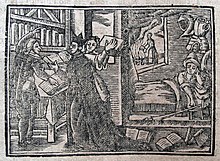
1741 woodcut illustrating the examination and burning of Don Quixote's library.
- In chapters 6 and 7 of the outset function of Don Quixote (1605),[71] his friends examine his library, full with chivalry romances and other books, and decide to burn nigh of them and seal the room. The comments of the priest let author Cervantes to praise or condemn the books.[72] [73]
- In his 1821 play, Almansor, the German author Heinrich Heine – referring to the burning of the Muslim holy book, the Qur'an, during the Spanish Inquisition – wrote, "Where they burn down books, so too will they in the end burn people." ("Dort, wo man Bücher verbrennt, verbrennt man auch am Ende Menschen.") Over a century later, Heine'southward ain books were among the thousands of volumes that were torched by the Nazis in Berlin's Opernplatz, even while his poem "Dice Lorelei" continued to exist printed in German schoolbooks every bit "by an unknown author".[74]
- Book burning played a small part in Journey to the Center of the Earth. After Professor Lidenbrock deciphers a writing of Arne Saknussem and attempts to recreate his purported subterranean journey, his nephew Axel protests that they should study more than of his works before making any rash decisions. Professor Lidenbrock explains that this is impossible: Saknussem was out of favor in his native land, whose leaders ordered all of his writings burned afterwards his death.
- In Fahrenheit 451, virtually a culture which has outlawed books due to its disdain for learning, books are burned forth with the houses they are hidden in.[72]
See also [edit]
- Banned books
- Library fires
- Listing of book-burning incidents
- Maya codices
- Blaze of the vanities
- Bibliophobia
Farther reading [edit]
- Baum, Wilhelm; Winkler, Dietmar W. (2003). The Church of the E: A Concise History. London-New York: Routledge-Curzon. ISBN9781134430192.
- Civallero, Edgardo. When Memory Turns into Ashes... Memoricide During the Twenty Century Archived 27 September 2011 at the Wayback Machine. DOI.
- Knuth, Rebecca (2006). Called-for Books and Leveling Libraries: Extremist violence and Cultural Destruction. Westport, Connecticut: Praeger.
- Knuth, Rebecca. Libricide : the regime-sponsored destruction of books and libraries in the twentieth century. ISBN 0-275-98088-Ten
- Ovenden, Richard Called-for the Books. London: John Murray[75]
- Polastron, Lucien X. 2007. Books on Fire: The Destruction of Libraries throughout History. Rochester, VT: Inner Traditions.
- The Bosnian Manuscript Ingathering Project – A call for Bosnian manuscripts ingathering
- Polastron, Lucien Ten. (2007) Libros en Llamas: historia de la interminable destrucción de bibliotecas. Libraria, ISBN 968-16-8398-half dozen.[ane]
- Polastron, Lucien Ten. Books on burn down: the devastation of libraries throughout history. ISBN 978-1-59477-167-5
- Raven, James. (2004). Lost Libraries: The Destruction of Groovy Book Collections Since Antiquity. Palgrave Macmillan Express.
- UNESCO. Lost Memory – Libraries and archives destroyed in the twentieth century
- Books on Burn down: The Devastation of Libraries Throughout History. Lucien Xavier Polastron. Translated past John E Graham. Inner Traditions. ISBN 978-1-59477-167-5. ISBN one-59477-167-7.
- Kilpeläinen, Kari (1995). "Sibelius 8. What happened to information technology?". Finnish Music Quarterly (4). Archived from the original on 5 March 2016. Retrieved 29 Nov 2015.
- Sirén, Vesa (October 2011a). "Is this the sound of Sibelius' lost Eighth Symphony?". Helsingin Sanomat.
- Sirén, Vesa (30 October 2011b). "Soiko HS.fi:due north videolla Sibeliuksen kadonnut sinfonia?". Helsingin Sanomat (in Finnish). Archived from the original on 17 Feb 2015. Retrieved eleven January 2015.
- Stearns, David Patrick (3 January 2012). "One last Sibelius symphony later on all?". Philadelphia Inquirer. Archived from the original on iv March 2016. Retrieved 11 Jan 2015.
References [edit]
- ^ "Holocaust Encyclopedia: Volume Burning".
- ^ Acts 19:18–xx
- ^ Edict by Emperor Constantine against the Arians. Athanasius (23 January 2010). "Edict by Emperor Constantine against the Arians". Fourth Century Christianity. Wisconsin Lutheran Higher. Archived from the original on 19 August 2011. Retrieved ii May 2012.
- ^ Elaine Pagels, Beyond Belief: The Secret Gospel of Thomas (Random Business firm, 2003), folio 176-177
- ^ "NPNF2-04. Athanasius: Select Works and Messages". Ccel.org. 13 July 2005. Retrieved 21 January 2012.
- ^ Knuth, R. (2006). Burning books and leveling libraries, p. 13. Praeger, London. ISBN 0275990079.
- ^ Downing, Alison; Atwell, Brian; Downing, Kevin. "Sigesbeckia orientalis" (PDF). Biology-Macquarie University. Section of Biological Sciences. Retrieved eight February 2021.
- ^ "Johann Georg Siegesbeck". Global Plants. JTSOR. Retrieved 8 February 2021.
- ^ "The Monks of Kublai Khan". Aina.org. Retrieved fifteen December 2017.
- ^ Chapman, John. "Nestorius and Nestorianism". New Advent. The Cosmic Encyclopedia. New York: Robert Appleton Company. Retrieved 25 January 2018.
- ^ Duncan McMillan, Wolfgang van Emden, Philip E. Bennett, Alexander Kerr, Société Rencesvals, Guillaume d'Orangish and the chanson de geste: essays presented to Duncan McMillan in celebration of his seventieth birthday by his friends and colleagues of the Société Rencesvals, Academy of Reading, 1984.
- ^ Edward Gibbon, The History of the Decline and Fall of the Roman Empire, 1776–89.
- ^ Rodkinson, Michael Levi (1918). The history of the Talmud, from the time of its formation, most 200 B. C. Talmud Club. pp. 66–75.
- ^ Maccoby, Hyam (1982). Judaism on Trial: Jewish-Christian Disputations in the Heart Ages . Associated University Presses. ISBN9780838630532.
- ^ Murray, S. A. P. (2009). The library: An illustrated history. Retrieved from https://ebookcentral.proquest.com
- ^ Cressy, David (2005). "Volume Called-for in Tudor and Stuart England". The Sixteenth Century Journal. 36 (2): 359–374. doi:ten.2307/20477359. JSTOR 20477359.
- ^ Murray, Stuart (2009). The Library: An Illustrated History. Chicago, IL: Skyhorse Publishin. p. 158. ISBN9781616084530.
- ^ Roth v. United States, 354 U.Southward. 476 (1957)
- ^ The Jewish Virtual Library – article The American-Israeli Cooperative Enterprise [Retrieved 2015-12-19]
- ^ Catholic encyclopedia, "Castilian Fleet".
- ^ "עכותור – מדריכי טיולים לעיר עכו ולכל הארץ | מדריך טיולים | מסלולי טיול לקבוצות עברית + צרפתית". Acco-tour.50webs.com. Retrieved 21 January 2012.
- ^ Gardner, Martin (2000). The Annotated Alice: The Definitive Edition. New York: Westward. W. Norton & Company. ISBN978-0-393-04847-6.
- ^ Paul Hoffman (2003). Wings of Madness . Hyperion. p. 277. ISBN0-7868-8571-8.
- ^ Arthur Japin (2016). O Homem com Asas (in Brazilian Portuguese). Translated by Cristiano Zwiesele do Amaral. São Paulo: Planeta practice Brasil. p. 285. ISBN9788542207545.
- ^ Lindskoog, Kathryn Ann (2001). Sleuthing C.Due south. Lewis: more Light in the shadowlands . Mercer University Press. pp. 111–12. ISBN0-86554-730-0.
- ^ Kilpeläinen 1995.
- ^ Sirén 2011a.
- ^ Sirén 2011b.
- ^ Stearns 2012.
- ^ "The war and the destruction of the eighth symphony 1939–1945". Jean Sibelius. Finnish Gild of Helsinki.
- ^ Ross, Alex (2009) [First published 2007]. "5". The Rest Is Dissonance: Listening to the Twentieth Century (third ed.). Harper Perennial. ISBN 978-ane-84115-476-3.
- ^ "Rangel, Carlos | Fundación Empresas Polar". Biblioteca de la Fundación Polar . Retrieved 12 July 2021.
- ^ "El profesor judío, por Gustavo J. Villasmil Prieto". Tal Cual. nineteen October 2019. Retrieved 12 July 2021.
- ^ O'Donnell, Jim (20 November 2003). "Patron saints". liblicense-l@lists.yale.edu (Mailing listing). Georgetown University. Retrieved ii May 2007.
- ^ Jaroslav J. Pelikan, Hilton C. Oswald, Luther'south Works, 55 vols. (St. Louis and Philadelphia: Concordia Pub. House and Fortress Press, 1955–1986), 46: 50–51.
- ^ Brooks, Geraldine (3 December 2007). "The Book of Exodus: A Double Rescue in Wartime Sarajevo" (PDF). The New Yorker . Retrieved 31 March 2012.
- ^ Lyons, Martyn (2011). Books:A Living History. Los Angeles: J.Paul Getty Museum. pp. 200–201. ISBN9781606060834.
- ^ Quoted in Publisher's Note to The Castle, Schocken Books.
- ^ Habegger, Alfred (2001). My Wars Are Laid Abroad in Books: The Life of Emily Dickinson . p. 604. ISBN9780679449867.
- ^ Farr, Judith, ed. (1996). Emily Dickinson: A Collection of Critical Essays. Prentice Hall International Paperback Editions. p. three. ISBN978-0-xiii-033524-1.
- ^ Shih, Gerry (9 December 2019). "China's library officials are burning books that diverge from Communist Party ideology". The Washington Post . Retrieved x Dec 2019.
- ^ Aziza Jafarzade, "Memoirs of 1937: Burning Our Books, The Arabic Script Goes Upwardly in Flames," in Azerbaijan International, Vol. 14:1 (Spring 2006), pp. 24–25.
- ^ Asaf Rustamov, "The Twenty-four hour period They Burned Our Books," in Azerbaijan International, Vol. 7:iii (Autumn 1999), pp. 74–75.
- ^ Bakery, G. Called-for Books. History Today. September 2006. (Pg 44)
- ^ Jorge Ramos (12 August 2012). "Ditadura Vargas incinerou em praça pública i.640 livros de Jorge Amado" (in Brazilian Portuguese). Archived from the original on 3 December 2019. Retrieved 24 May 2021.
- ^ Keating, Sara (ane January 2006). "Bringing tales of the tailor back home". The Irish Times . Retrieved 19 Dec 2010.
- ^ Reich, Wilhelm (1897–1957), International Dictionary of Psychoanalysis
- ^ Zachary Silver, "A look dorsum at a unlike book burning," The Frontwards, 3 June 2005
- ^ "Fantomet på bålet 1955". Danmarkshistorien.dk. 9 April 1940. Retrieved 15 December 2017.
- ^ GREENHALGH, R. D. (2020). "Os livros e a censura em Brasília durante a Ditadura Militar (1964-1985)" [Books and Censorship in Brasília during the Armed services Dictatorship (1964-1985)]. Informação & Sociedade: Estudos (in Brazilian Portuguese). 30 (3): 1–xv. doi:10.22478/ufpb.1809-4783.2020v30n3.52231. Archived from the original on 24 May 2021. Retrieved 24 May 2021.
- ^ Knuth, Rebecca. Burning Books and Leveling Libraries: Extremist Violence and Cultural Devastation. Praeger Publishers, 2006, p. 84.
- ^ Thompson, Lawrence Due south. (1985). "Biblioclasm in Norway". Library & Archival Security. half-dozen (4): 13–xvi. doi:10.1300/j114v06n04_02.
- ^ Knuth, Rebecca. Burning Books and Leveling Libraries. Westport, Connecticut: Praeger, 2006.
- ^ Ruggiero, Lucia. (n.d.). Digital books; could they brand censorship and "book burning" easier? Digital Meets Culture. Retrieved 22 October 2015, from http://www.digitalmeetsculture.net/article/digital-books-could-they-make-censorship-and-book-burning-easier/ See also Deletionism and inclusionism in Wikipedia for information most this phenomenon on Wikipedia.
- ^ Streitfeld, David (17 March 2020). "Amazon Bans, and then Reinstates, Hitler's 'Mein Kampf'". The New York Times.
- ^ Noted in Touring Order Italiano, Roma e Dintorni 1965:344.
- ^ Bosmajian, Haig (2006). Burning Books. Jefferson, North Carolina: McFarland & Visitor, Inc. p. 141. ISBN0786422084.
- ^ "The books have been burning - World - CBC News". Cbc.ca. Retrieved 15 December 2017.
- ^ Edwards, Jorge. "Books in Chile," Index on Censorship nº 2, 1984, pp. twenty–23.
- ^ Andrain, Charles. Political Modify in the 3rd World, 2011, p. 186.
- ^ Whitbourn, Michaela (xv Oct 2018). "Cocky-styled healer Serge Benhayon leads 'socially harmful cult': jury". Sydney Morning Herald. Fairfax Media.
- ^ Leser, David (25 August 2012). "The Da Vinci Mode". Sydney Morning Herald . Retrieved 5 January 2015.
- ^ "Turkish government destroys more than 300,000 books". the Guardian. half dozen August 2019. Retrieved 19 December 2021.
- ^ P, Jinoy Jose. "When 301,878 books were murdered in Turkey..." The Hindu Business organization Line. Archived from the original on 8 August 2019. Retrieved nineteen December 2021.
- ^ "Turkey burns 300,000 books from schools and public libraries". ZME Scientific discipline. seven August 2019. Retrieved 19 December 2021.
- ^ Gerbet, Thomas (7 September 2021). "Des écoles détruisent 5000 livres jugés néfastes aux Autochtones, dont Tintin et Astérix" [Schools destroy 5,000 books deemed harmful to Indigenous people, including Tintin and Asterix]. Radio-Canada.ca (in Canadian French). Archived from the original on 7 September 2021.
- ^ "Presss Release BC Sikh Customs" (PDF). Harjas.com. Archived from the original (PDF) on fifteen June 2007.
- ^ "4 copies damaged in New Orleans by the flood caused by Hurricane Katrina". Sikhnn.com. Archived from the original on seven October 2007.
- ^ "on the Nicobar Islands subsequently the 2004 seismic sea wave (stop of page)". unitedsikhs.org.
- ^ "Web log query well-nigh an accumulation of download printouts of Sikh sacred text". Mrsikhnet.com. Archived from the original on ten Jan 2008.
- ^
 Works related to Don Quixote/Volume 1/Chapter VI at Wikisource
 - ^ a b Romera, Ángel (March 2005). Aguirre, Joaquín María (ed.). "Escrutinio de donosos escrutinios. Estela de los bibliocaustos generados por united nations capítulo de Don Quijote". Espéculo (in Castilian). Madrid: Universidad Complutense (29). Retrieved 30 September 2021.
- ^ Peña, Manuel (thirty December 2005). "El "donoso y grande escrutinio" o las caras de la censura" [The "diverting and important scrutiny" or the faces of censorship]. Hispania (in Castilian). CSIC. 65 (221): 939–955. doi:10.3989/hispania.2005.v65.i221. Retrieved 30 September 2021.
- ^ Henley, Jon (ten September 2010). "Volume-burning: fanning the flames of hatred". The Guardian . Retrieved 25 December 2012.
- ^ Burning the Books by Richard Ovenden review – the libraries we take lost; The Guardian; 31 August 2020; accessed 2020-09-02
External links [edit]
- "On Book Burnings and Book Burners: Reflections on the Power (and Powerlessness) of Ideas" past Hans J. Hillerbrand
- "Burning books" by Haig A. Bosmajian
- "Bannings and burnings in history" – Book and Periodical Council (Canada)
- "The books have been burning: timeline" by Daniel Schwartz, CBC News. Updated 10 September 2010
wimbishcapaidep1952.blogspot.com
Source: https://en.wikipedia.org/wiki/Book_burning
0 Response to "Were Book Burners Too We Read the Books and Burnt Them"
Post a Comment